



WE ARE STM

Pada 28hb June 2010, kami dari STM telah mengadakan kejutan kepada Dr Jameela Sathar sempena hari jadinya. Ianya telah diatur dengan kerjasama jururawat dan mereka di bahagian Klinik Harian di Aras 3, Hospital Ampang. Kebetulan hari tersebut adalah hari bagi kami perlu membuat FBC.
Walaupun ianya sesuatu yang kecil dari kami pesakit Thalassaemia namun pengertian pengorbanan yang dicurahkan oleh Dr Jameela adalah terlalu besar untuk kami balas. Dengan sebiji kek 'seteskop', makanan ringan dan minuman, Dr Jameela telah meluangkan masa kira-kira 2 jam bersama kami dan jururawat lainnya.
Dengan tugasannya yang mencemburui, Dr Jameela masih boleh memberi nasihat dan memberi kami kata-kata semangat. Turut dibincangkan adalah arah tuju kami dan masa depan yang boleh dilakukan oleh setiap dari kita untuk masa depan yang lebih ceria dan indah.
Thank you..., Doc... :))


Read More »

Penang Hospital’s blood bank indicator on a tower on Jalan Residensi has been red for the past few weeks.
The signal will be yellow to show a medium supply and green when there is adequate supply.
Running low: The red light is on at the tower to indicate an urgent need for more blood supply.
Penang Hospital medical transfusion unit head Dr Soo Peng Yen said the unit had to consider a few factors before deciding which light to turn on.
“Although we have more than 1,000 pints of blood in the blood bank now, we are running low in platelet supply which is useful for leukaemia or other cancer treatment,” she said on Thursday.
“Sometimes, we may have sufficient blood but be short of a particular blood group so we still have to show a red indicator. It is best to stock up to prepare for any eventualities.”
Donors can walk in from 7.30am to 5.30pm on weekdays except public holidays. Anyone aged between 18 and 65, and weighing 45kg and above can donate blood.
Dr Soo said blood donors should get a good night’s sleep the night before and not donate on an empty stomach. For details, call the blood bank at 04-2225161.
Copyright © 1995-2010 Star Publications (M) Bhd (Co No 10894-D)
Read More »
Utusan Malaysia Online - Forum
ARKIB : 14/06/2010
Penjelasan Persekutuan Pertubuhan Talasemia Malaysia
ARKIB : 14/06/2010
Penjelasan Persekutuan Pertubuhan Talasemia Malaysia
Akhbar Utusan Malaysia dan Metro melaporkan bahawa terdapat sebuah badan yang bernama Berkat atau Badan Kebajikan Talasemia Malaysia akan menganjurkan Majlis Amal Juta Hati pada 24 Julai 2010 di sebuah hotel di Kuala Lumpur.
Dalam kenyataan Setiausaha Kehormatnya Encik Ahlias Md. Yusof beliau menyatakan majlis itu bertujuan untuk mengumpul dana untuk membantu pesakit talasemia di negara ini. Beliau menyatakan bahawa pesakit talasemia memerlukan perbelanjaan rawatan termasuk pemindahan darah sejumlah RM800 sebulan untuk meneruskan hidup.
Untuk makluman tuan, sejak 2006 Kementerian Kesihatan telah meluluskan peruntukan untuk kos rawatan pesakit talasemia sejumlah lebih RM30 juta dan semua rawatan pesakit talasemia adalah percuma termasuk proses pemindahan darah.
Kenyataan Setiausaha Kehormat Berkat itu adalah mengelirukan. Orang ramai diminta menghubungi hospital kerajaan atau Kementerian Kesihatan berhubung dengan dakwaan Berkat itu.
Berkat telah kerap kali menganjurkan pelbagai program kutipan dana dan majlis makan malam untuk pesakit talasemia seperti yang didakwa tetapi kita tidak tahu ke mana dana ini disalurkan.
Persekutuan Pertubuhan Talasemia Malaysia (PPTM) mempunyai ahli iaitu persatuan talasemia di setiap negeri dan semua pesakit talasemia direkodkan di jabatan pediatrik dan jabatan perubatan di setiap hospital kerajaan. Tidak ada daripada mereka yang pernah menerima bantuan atau sumbangan dari Berkat selama ini.
Persekutuan Pertubuhan Talasemia Malaysia meminta orang ramai menghubungi hospital kerajaan atau kementerian kesihatan mengenai sebarang usaha untuk mengumpul dana bagi pesakit talasemia di negara ini supaya ia benar- benar untuk kepentingan pesakit dan tidak disalah guna.
Maklumat lanjut sila hubungi Persekutuan Pertubuhan Talasemia Malaysia Tel: 012 4306340, 04 7303039 (Faks) atau hubungi Datuk Dr. Zulkifli Ismail, Pengerusi Persatuan Talasemia Malaysia di talian 012 2144155.
RAMLI MOHD. YUNUS
Presiden (PPTM)
© UTUSAN MELAYU (M) BERHAD, 46M, Jalan Lima Off Jalan Chan Sow Lin, 55200 Kuala Lumpur.
Read More »


Persatuan Thalassaemia Malaysia
3rd Floor, National Cancer Society Building,
66, Jalan Raja Muda Abdul Aziz
50300 Kuala Lumpur
Tel : 03-26941141 Fax : 03-26941142
Email : malaysiathalassaemia@yahoo.com
pertam@po.jaring.my
Thalassaemia Society Of University Hospital
Address: Department Of Paediatrics,
University Hospital, Lembah Pantai,
59100 Kuala Lumpur.
Tel: 03-79502275 Fax: 03-79556114
The Penang Thalassaemia SocietyAddress : Room CO-38 & 39 UP, Kompleks Masyarakat Penyayang
Jalan Utama, 10450 Pulau Pinang.
Tel/Fax: 04-2272133
E-mail: penthal@streamyx.com
Patron: YABhg Toh Puan Datin Seri Hajah Majimor bt Sharif
THALASSAEMIA CLINICS
Klinik Pakar Kanak-Kanak,
Penang General Hospital
Tel: 04-2002299
Ambulatory Care Centre (ACC),
Unit Rawatan Harian Perubatan (Day Care Centre),
2nd Floor, Haematology - Thalassaemia Adult & Paediatric
Persons in Charge:
Zailawati Bt Mamat ( Adult ),
S/N Noorhafisah Bt Radzi (Paediatrics )
Tel: 04-2293333 Ext 2809
Klinik Pakar Kanak-Kanak,
Seberang Jaya Hospital, Prai.
Tel: 04-3983333
FEDERATION MALAYSIA THALASSAEMIA SOCIETY
Address : 5017, 1st Floor Bangunan PKNK,
Jalan Tun Abdul Razak
05200 Alor Setar,
Kedah Darul Aman.
Tel: 04-7303039
THALASSAEMIA SOCIETIES OF OTHER STATES
Johor Thalassaemia Society
Address: Lot 5395, Jalan Kurniawati
Jalan Kurniawati,
Kampung Kurnia,
80250 Johor Bahru.
Tel: 07-3320369 Fax: 07-3332724
Kedah Thalassaemia Society
Address: C/O No. 97,
Taman Nuri Jalan Dato Kumbar,
05300 Alor Setar,
Kedah Darul Aman
Tel/Fax: 04-7306340
Malacca Association Of Thalassaemia
Address: No. 21,
Jalan Malinja 1 ,
Taman Malinja,
75150 Bukit Baru, Melaka.
Tel/Fax: 06-2836937
Sabah Thalassaemia Society
Address: P.O. Box 22748,
88787 Luyang Kota Kinabalu, Sabah.
Tel/Fax: 08-8252176
Sarawak Thalassaemia Society
Address: C/O 8 Kim San Court,
93200 Kuching, Sarawak.
Tel: 082-240881 Fax: 082-415691
Perak Thalassaemia Society
Address: No.44, (1st Floor) Jalan Masjid,
30300 Ipoh, Perak
Tel/Fax: 05-2432470
Kuantan Thalassaemia Society
Address: No.8, Lorong Air Putih 1,
Off Jalan Beserah, 25300 Kuantan,
Pahang Darul Makmur.
Tel/Fax: 09-5669180
Kelantan Thalassaemia Society
Address: Lot 1251,
Level 1 Depan Istana Mahkota Yahaya Petra,
Jalan Sultan ,Kubang Kerian,
15200 Kota Bahru, Kelantan.
Tel: 09-7646206 Fax: 09-7646208
Thalassaemia Society Of University Hospital
Address: Department Of Paediatrics,
University Hospital, Lembah Pantai,
59100 Kuala Lumpur.
Tel: 03-79502275 Fax: 03-79556114
Read More »
What Is Thalassemia?
(also known as Mediterranean anemia, or Cooley's Anemia) is a genetic blood disease. People born with this disease cannot make normal hemoglobin (anemia) which is needed to produce healthy red blood cells.
Who carries Thalassemia?
People of Chinese, South Asian, Middle Eastern, Mediterranean or African origin.
What is Thalassemia Minor?
People with a thalassemia mutation only in one gene are known as carriers or are said to have thalassemia minor. Thalassemia minor results in no anemia or very slight anemia. People who are carriers do not require blood transfusion or iron therapy, unless proven to be iron deficient.
What is Thalassemia Major?
Children born with thalassemia major usually develop the symptons of severe anemia within the first year of life. Lacking the ability to produce normal adult hemoglobin, children with thalassemia major:
- are chronically fatiqued
- fail to thrive, and
- do not grow normally
Prolonged anemia will cause bone deformities and eventually will lead to death within the first decade of life. The only treatment to combat severe anemia is regular blood transfusions.
How can Thalassemia be treated?
Regular blood transfusions allow patients with thalassemia major to grow normally and be active. Unfortunately, transfusions result in deadly accumulation of iron in the hearts and livers of patients by their teenage years. If the excess iron is not removed then the patients may suffer from a premature death due to iron overload.
Nowadays, drugs designed to remove excess iron (iron chelators) have significantly changed the prognosis of thalassemia major. Patients can grow and develop normally, with relatively normal heart and liver functions. Adult patients are living into their forties and some have children of their own.
Despite improved prognosis, many patients find the nightly 10 hour infusions difficult or painful and are reluctant to comply with their doctor's orders. These patients are not free of risk and may die prematurely due to iron overload.
Current treatments allow thalassemia patients to live relatively normal lives, however, a cure remains to be found. The genetic cause of thalassemia was one of the first genes discovered in the 1970's, yet 30 years later, gene therapy still eludes thalassemia patients.
Do you carry Thalassemia?
Many people from the areas of the world where thalassemia is common carry the gene for it on one chromosome (that is, they have thalassemia minor). You may believe that your blood has been tested for this specific gene but testing for thalassemia requires a special blood test. To be tested your doctor must order a blood test called HEMOGLOBIN ELECTROPHORESIS which can identify a carrier of thalassemia.
If you, your parents or ancestors are from an area of the world where thalassemia is common, PLEASE REQUEST hemoglobin electrophoresis blood test from your doctor.
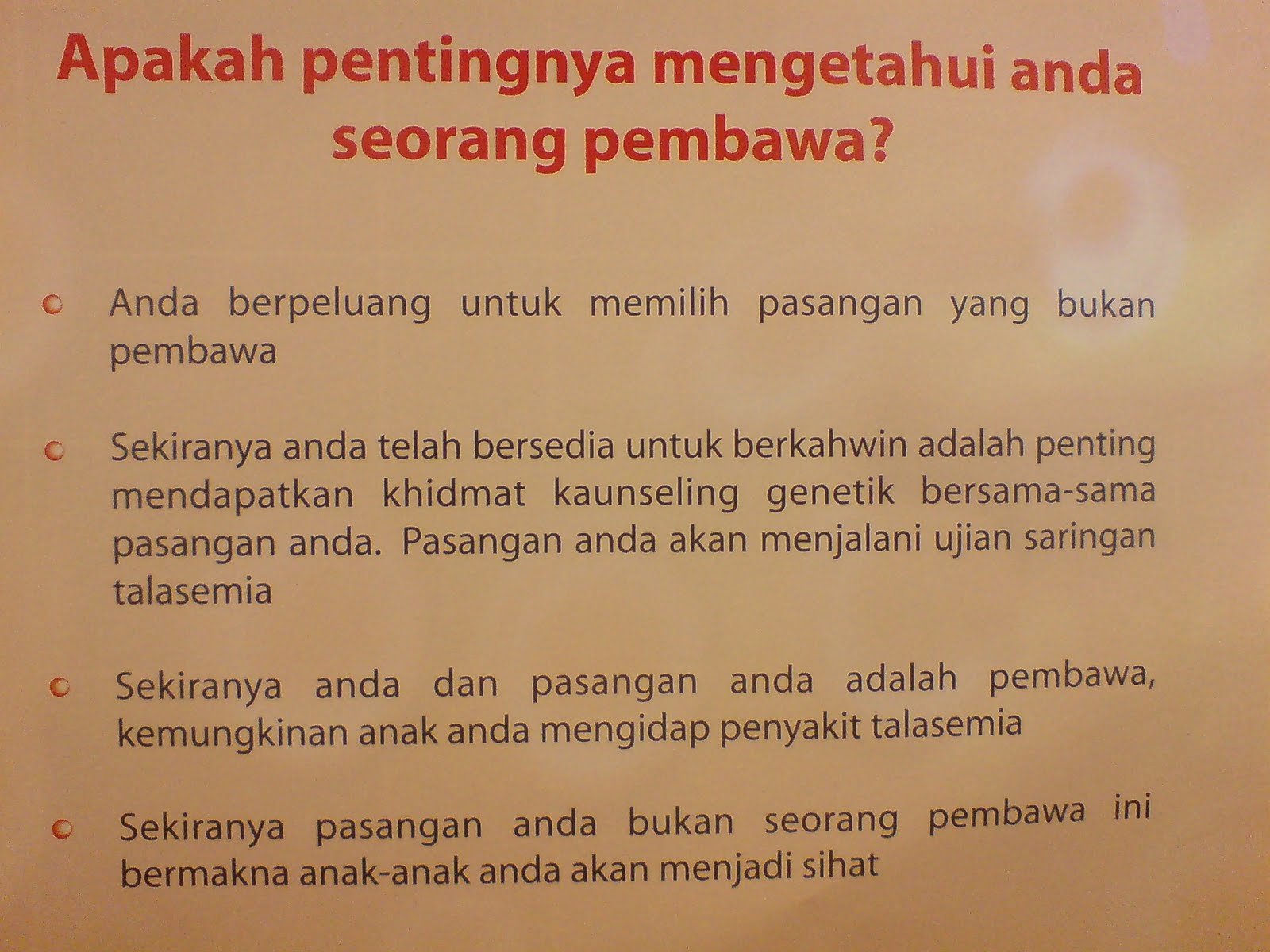
It is important to identify yourself as a possible carrier of thalassemia (thalassemia minor). A person with thalassemia minor has a 25%(1 in 4) chance of having a baby with THALASSEMIA MAJOR if his/her mate also has thalassemia minor.
How do you inherit Thalassemia?
If both parents carry thalassemia minor, their children may have thalassemia minor, or they may have completely normal blood, or they may have thalassemia major. In each pregnancy there is a one in four (25%) chance that their child will have normal blood, a two in four (50%) chance that the child will have thalassemia minor or a one in four (25%) chance that the child will have thalassemia major.
How can we prevent Thalassemia?
Please share the information on this website with others. Show it to your family, friends, neighbours, coworkers or anyone who has origins from areas where thalassemia is common. Be sure to ask your doctor to test you for thalassemia minor. Increased awareness is the key.
Does a cure exist?
Presently, the only available treatment for iron overload in thalassemia patients is pump-infusion therapy. Patients that cannot tolerate the side-effects of the daily injections or medicine may refuse this burdensome therapy and eventually die of iron overload.
A cure needs to be found. Please do your part by spreading the word.
http://www.thalassemia.ca/
Read More »
Subscribe to:
Posts (Atom)


 Posts



